

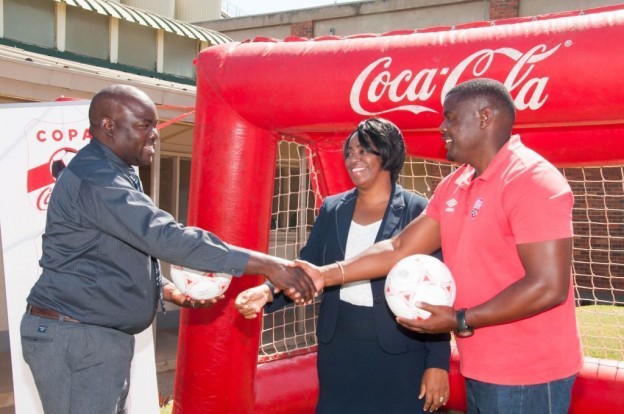
 More than 5,000 schoolchildren from across the country stand the chance of football stardom with the launch of this year’s COPA Coca-Cola grassroots school soccer tournament – now in its 22nd year.
COPA Coca-Cola is the premier grassroots football tournament sponsored by the drinks brand in partnership Zambia Schools Sports Association (ZASSA) and the Ministry of Education. The initiative commenced in 1993 with only 100 schools participating and has now grown to include 450 government and private schools in Zambia.
The tournament also has a number of professional football players among its alumni including 2012 AFCON winners Stoppila Sunzu and Kennedy Mweene.
“For close to 98 years now, Coca-Cola has associated its brand with football. Because of our long-standing involvement with football, we understand and share the fans’ passion for the sport. As the world’s most popular sport, football attracts countless young people who hope to one become professional soccer stars one day. Coca-Cola, the world’s most valuable brand, promotes COPA Coca-Cola programmes in several nations to help many teens take strides toward making those dreams a reality. We are proud of our efforts to help football grow and develop in Zambia, at all levels,” said Zambian Breweries Managing Director, Annabelle Degroot.
The sponsorship package has grown annually, with the 2015 package set at US$220,000 (K1,540,000) going towards prize money, transport and logistics, accommodation and meals for teams and officials, kits and other Coke branded clothing, soccer balls, hire of football pitches and payment to referees. The 2014 sponsorship package was US$180,000.
This year’s package includes for the first time support for girls’ teams, with kits and soccer balls and plans to develop girls’ teams further as the organisers study the roles and structures of the tournament.
About 450 schools teams will play in this year’s tournament, with knock-out games being played at regional level. The top schools in each region go on to provincial tournaments. A total of ten schools – one from each province – then qualify for the national championship finals in Lusaka later in the year.
The national games are played in the capital over five days, during which the best 13 players are selected to form the country’s COPA Coca-Cola team that travels for international camps for ten days.
In recent years camps have been held in Brazil, South Africa and England and comprise both developmental and competitive games. Participants interact with other boys from various parts of the world and are trained by expert coaches.
In 2011, the Zambia’s 2010 “dream team” won the international camp tournament that was played at Chelsea Football Club in England.
“We combine top-class competition between the best young soccer talent on the African continent with educational and team building exercises that will enrich their lives and equip them with new skills to take back to their home countries,” explained Mr. Albert Mulei, Senior Operations Manager for the Coca-Cola Company Zambia.
As part of its ‘Live for a Difference’ committment to communities, COPA Coca-Cola promotes an active, healthy lifestyle while fostering teens’ interest in soccer. The tournament offers youth an opportunity to meet and interact with peers across the country as well as other nations. The programme also provides opportunities to recognise rising soccer talent among community youth.
In order to broaden their exposure and heighten their aspirations to become “the best of the best” in football, Coca-Cola also leverages its unique association with FIFA to give the young stars a once-in-a-lifetime experience to watch an international match live.
Across Africa, COPA Coca-Cola is played in 23 other countries that include Kenya, Uganda, Tanzania, Ethiopia, Angola, Mozambique, Malawi, Botswana, Namibia, Rwanda, Congo, Swaziland, Nigeria and South Africa, Lesotho, Madagascar, Mauritius and Burundi. Outside the continent, COPA Coca-Cola is also played in the Americas, Europe and Asia and is in a total 64 countries over 1.3 million players.
Well spoken! I totally agree with you that we cannot have a healthy and growing business unless the communities we serve are healthy and sustainable. Let this message resonate in the minds of all company leaders in Zambia to support grass root football tornerments so that we broaden the exposure of our youth and heighten their aspirations to become “the best of the best” in football.
The drinks brand company have done it again to organize and launch the premier grassroots football tournament in Zambia. Many thanks also go to the Zambia Schools Sports Association (ZASSA) for partnering with them and am sure because of this, one of them deserves a free seat in the FAZ executive board.
I am also deeply impressed by the drinks brand company that is behind the initiation of this future success story of the Coca-Cola premier grassroots football tournament. I appeal to other companies in Zambia to emulate their example of sponsoring and organizing schools teams to play in annual tournaments, with knock-out games being played at regional level.
Let it be recorded on this day that we the people of Zambia are thankful to them for thier commitment to improving the quality of life in our communities where they do business through sponsoring and organizing football tournerments.
Such tournaments can help us tap talent from all the provinces of mother Zambia which I think is not currently reflective of our Zambia football national team today. That’s why whenever a Zambian player in our national team performs badly, I console myself by saying there surely must be a better player somewhere in Zambia who can do a better job if given a chance.
Lets encourage our new president of FAZ Andrew Kamanga by giving him ideas upon which to boost his vision and passion for our national team.
Let us help him to translate this passion into practical ways, so that he can usher our national team to greater heights. I believe we can build our national team on vibrant principles such as those in the movie called “The Titans,” where they transformed their difficulties into positive anchors in order to build a more cooperative and successful team. I am using the Titans as an example because it is based on a true story.
I am aware that the Chipolopolo have been drawn in Group B along with Africa’s highest ranked team Algeria and seasoned campaigners Cameroon and Nigeria. However, it is possible that if we collectively do our homework right, we will be able to repeat history by beating these big teams. An additional suggestion in order to realize this goal is to encourage the coach to adopt an authoritarian coaching style which emphasizes perfection and pushing players to the limit in order to help the team become more cohesive and strong. We need to encourage the assistant coach to strike a balance by having democratic coaching style which is basically more concerned about the well-being of the players and not just their success.
Lastly let us make our football games scientific and not just physical by embracing principles of sports psychology to manage our team and tapping talent from all parts of the country through grass route tounerments. Let us recognize the rising football talent among our community youth in all parts of the country through supporting grassroots football tournaments.