


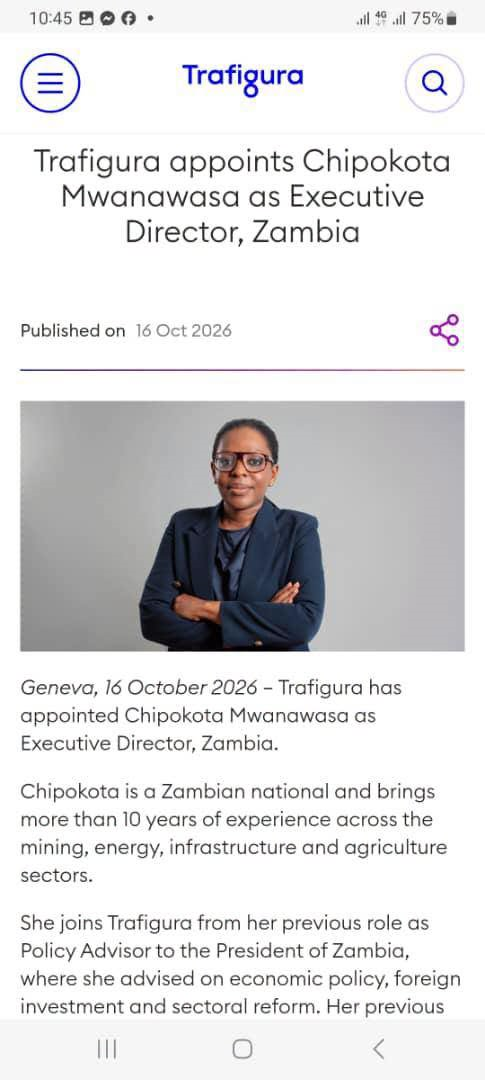
 LUSAKA – Chipokota Mwanawasa has been appointed Executive Director for Zambia at global commodities trading company Trafigura, days after leaving her position as Policy Advisor to President Hakainde Hichilema at State House.
Trafigura announced the appointment on Friday, October 16, 2026, confirming that Mwanawasa will be based in Lusaka and lead the company’s activities in Zambia across metals and minerals, energy and associated logistics operations.
Her responsibilities will also include strategic business development and engagement with commercial, institutional and government stakeholders.
The appointment clarifies the destination of Mwanawasa’s transition from government to the private sector, which State House announced in a statement dated October 16.
Mwanawasa previously served as Deputy Head of the Presidential Delivery Unit, where she supported implementation of Zambia’s Eighth National Development Plan, before becoming Policy Advisor to the President.
Her move places her in a senior position at a company with interests spanning some of Zambia’s most important economic sectors, including copper trading, petroleum supply, fuel distribution and logistics infrastructure.
What will Mwanawasa do at Trafigura?
According to the company’s announcement, Mwanawasa will oversee its activities in Zambia and coordinate engagement with government, institutions and commercial partners.
Trafigura said her responsibilities would cover metals and minerals, energy and associated logistics, including strategic business development.
She will also support the group’s subsidiaries operating in Zambia, including Puma Energy, which is involved in fuel storage, distribution and retail, and Servara, the group’s logistics, storage and transport platform formerly operated under the Impala Terminals brand.
The role places Mwanawasa at the intersection of commodities trading, infrastructure, energy supply and government engagement.
These are sectors in which policy decisions, investment conditions, transport capacity and access to international markets can influence business operations and national economic performance.
In her statement accompanying the appointment, Mwanawasa said Zambia was central to global supplies of copper and other minerals, while the energy sector underpinned the country’s economic development.
She said she looked forward to strengthening the company’s relationships in Zambia and building on its existing operations.
From presidential policy advice to commodities trading
Mwanawasa leaves State House after serving as Policy Advisor to Hichilema, a position in which Trafigura says she advised on economic policy, foreign investment and sectoral reform.
Her previous role as Deputy Head of the Presidential Delivery Unit involved supporting implementation of the Eighth National Development Plan, which guides the country’s development priorities.
Her professional background also includes direct mining-sector experience through her previous work at Konkola Copper Mines, one of Zambia’s major copper producers.
Trafigura said she brings more than 10 years of experience across mining, energy, infrastructure and agriculture.
Her career has therefore included work within the mining industry, government policy and development implementation, before moving into a senior role with an international commodities trader.
The appointment also brings her experience in government and industry into a role requiring engagement with both public institutions and commercial stakeholders.
Her new responsibilities will include dealing with government and institutional partners, although the precise structure of those engagements and the company’s priorities under her leadership have not been detailed publicly.
Why Trafigura matters to Zambia
Trafigura is one of the world’s major independent commodities trading companies. It connects producers and consumers of energy and raw materials through trading, financing, infrastructure and logistics.
The company says it has operated in Zambia for more than 20 years, serving customers across energy, metals and minerals.
According to its announcement, the group and its subsidiaries employ approximately 300 people in Zambia and operate 29,000 square metres of storage space in Ndola through Servara.
Its operations also include Puma Energy, which Trafigura says operates approximately 74 fuel retail sites, four terminals and three aviation fuel sites in the country.
These activities give the group a presence in both the commodities that Zambia produces and the energy products it imports and distributes.
Copper and other minerals are important to Zambia’s export earnings and industrial ambitions. The country has also been seeking to expand copper production, attract investment and improve the infrastructure needed to move minerals to international markets.
At the same time, reliable fuel supplies and efficient logistics are essential for mining operations, transport, manufacturing and other businesses.
Trafigura’s trading and infrastructure activities therefore place it within several parts of the country’s wider economic system.
Mwanawasa’s appointment will be watched in the context of these operations, although the company has not announced specific new investments or policy initiatives tied to her arrival.
Puma Energy, Servara and the wider group
Two of the businesses identified in Trafigura’s announcement are particularly relevant to Zambia’s energy and logistics sectors.
Puma Energy operates in the downstream petroleum market, including fuel importation, storage, distribution and retail. Its activities place it within the supply chain that connects petroleum products to businesses, transport operators, aviation customers and motorists.
Servara provides storage, transport and logistics services. Trafigura says its Zambian operations include storage infrastructure in Ndola, an important industrial centre in the Copperbelt.
These businesses complement Trafigura’s broader commodity-trading activities by providing infrastructure and distribution capacity alongside its international trading operations.
Their presence also means that Mwanawasa’s new role will extend beyond trading transactions to include oversight and support for businesses with physical assets and operations in Zambia.
However, the company has not provided a detailed breakdown of the commercial targets or operational changes she will be expected to deliver.
What the appointment means for Zambia’s economic agenda
Mwanawasa’s appointment comes as Zambia continues to pursue investment in mining, energy and infrastructure while seeking to expand economic activity and strengthen its position in international commodity markets.
Trafigura’s operations touch several issues relevant to that agenda, including mineral exports, petroleum supply, storage capacity and the movement of commodities.
Her role could provide a focal point for the company’s engagement with Zambian institutions and commercial partners. The extent to which that translates into new investment, expanded infrastructure or additional business opportunities will depend on future decisions and projects.
For now, the appointment announcement establishes her responsibilities but does not set out new investment commitments, employment targets or changes to the company’s existing operations.
The practical significance of her appointment will therefore become clearer through the initiatives the company pursues and the outcomes achieved during her tenure.
The governance question: Moving from public office to business
Mwanawasa’s move from the Presidency to a company active in sectors affected by government policy also raises a broader question about how transitions between public service and private business are managed.
Her previous responsibilities included advising the President on economic policy, foreign investment and sectoral reform. Her new role involves strategic business development and engagement with government and institutional stakeholders on behalf of a private company.
That overlap makes transparency around any applicable post-public-service obligations, confidentiality requirements and conflict-of-interest safeguards important.
However, the fact that a former government official takes up a private-sector role does not, by itself, establish a conflict of interest or wrongdoing. Any such concern would need to be assessed against specific decisions, duties, applicable rules and evidence.
Neither the State House announcement nor Trafigura’s appointment statement identifies a breach of any rule or raises an allegation of misconduct against Mwanawasa.
The available information also does not establish whether she was involved in any specific government decision directly affecting Trafigura before leaving office.
The relevant issue is therefore how the transition is managed, rather than an assumption that her previous position and new employment are inherently incompatible.
Trafigura’s international profile
Trafigura operates across international energy and commodities markets and has businesses and infrastructure in multiple countries.
Like other major commodities traders, its activities operate within a global industry that faces scrutiny over supply-chain transparency, environmental impacts, commercial conduct and the responsibilities of companies trading natural resources.
Those broader industry issues are relevant context, but they should not be treated as evidence of misconduct in the company’s Zambian operations or as an allegation against Mwanawasa.
A full assessment of the company’s record would require examining specific documented cases, regulatory findings and the company’s responses rather than relying on general descriptions of international controversies.
Trafigura’s announcement of Mwanawasa’s appointment focuses on its long-term presence in Zambia and the importance of metals, minerals, energy and logistics to its operations.
What happens next?
Mwanawasa is expected to lead Trafigura’s activities in Zambia from Lusaka, coordinating its business development and engagement with government, institutions and commercial partners.
The appointment provides a clear picture of her new position and the sectors she will oversee. What remains to be seen is whether her arrival will be followed by new investments, expanded infrastructure or changes in the group’s commercial priorities in Zambia.
For Zambia, the significance of the appointment lies not only in the move of a former presidential policy adviser into the private sector, but also in the role she will play at a company with established interests in minerals, fuel and logistics.
Zambian Eye will follow developments in Trafigura’s operations and Mwanawasa’s new role as further details emerge.
For now, the appointment marks a transition from advising the President on economic policy to leading the Zambian activities of a global commodities trading group whose operations intersect with several of the country’s major economic priorities.