
 By Tarcisius Mukuka
Introduction
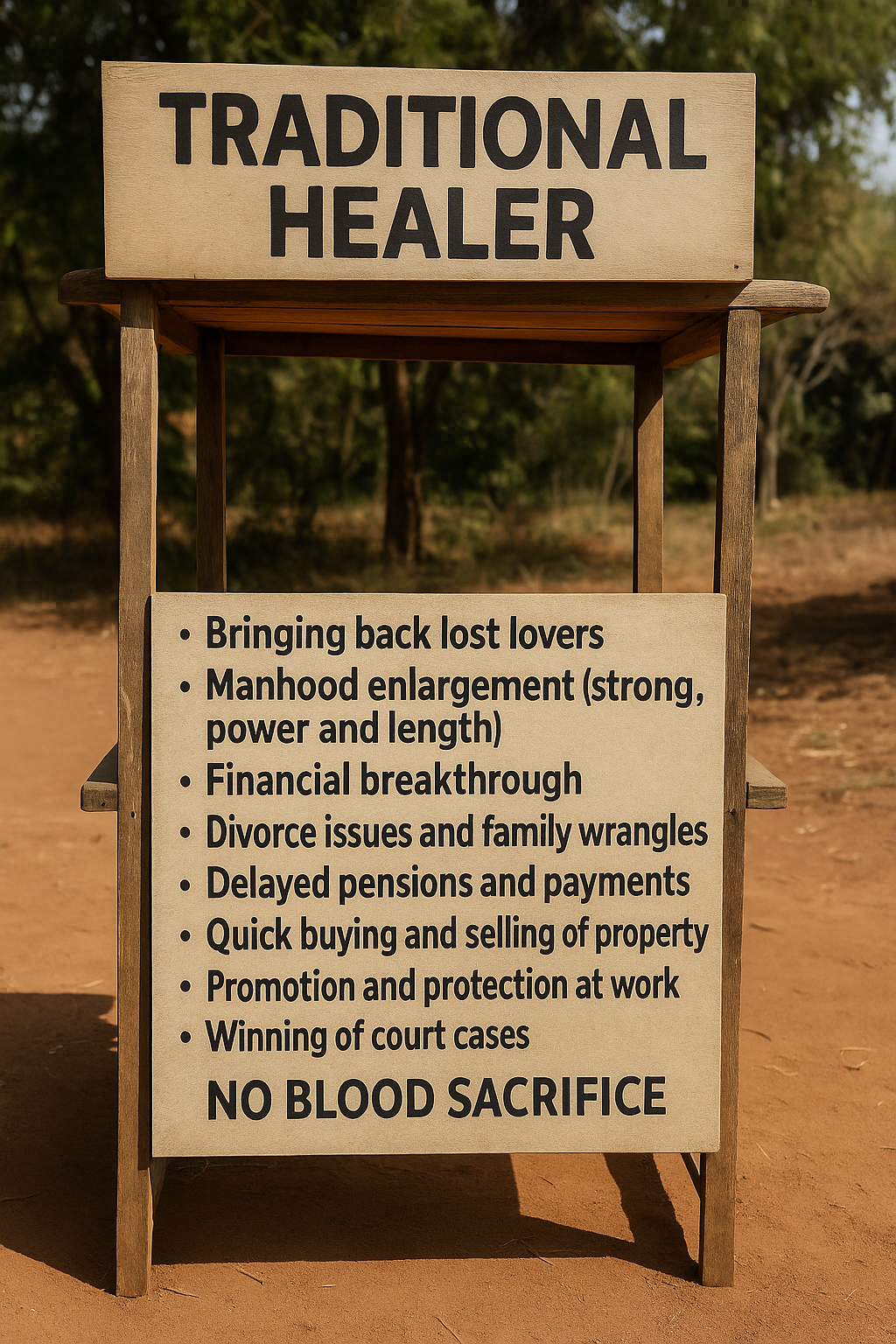
My Sunday morning ritual before being glued to the Premiership matches on DSTV includes catching up with news from two sources: The Sunday Nation and The Mast on Sunday. Leafing through the latter I came across two Classified Ads from traditional healers promising to solve: problems of lost lovers, manhood enlargement, financial breakthrough, divorce issues and family wrangles (wrongly spelt “rangles”), delayed pensions and payments, quick buying and selling of property, promotion and protection at work, and winning of court cases. There you are in black and white, an alternative economy gone viral and digital.
 My Beef with Digital Sangomas and Healers
While every other service in Zambia — from selling bottled water to running a barber shop — must pass through some gauntlet of regulation, sangomas and traditional healers enjoy a curious exemption. No Zambia Bureau of Standards certification, no Ministry of Health oversight, no Consumer Protection inspection. Yet they are the only “service providers” allowed to plaster public spaces with lurid adverts promising everything from manhood elongation to instant political promotion — complete with the fine print assurance: No blood sacrifice. It is a parallel non-taxable economy of miracles, unburdened by accountability, and yet oddly protected by our collective silence and secret patronage.
Classified Ads with a Caveat
The two Ads from The Mast added the assurance: “No blood sacrifice.” This disclaimer is priceless: like a butcher shop proudly declaring, “Vegetarian-friendly sausages.” This is how you know the market for miracles has gone fully retail, digital and viral. I wondered whether The Mast had any ethical qualms about printing such hogwash. On the “bright” side, with such service deliverers as sangomas and traditional healers at our disposal, who needs to go to work, hospital, marriage counsellor, court or work hard in order to be promoted? And why the proliferation?
- The Business of Hope
The answer seems to be two-fold. First, where others see despair, sangomas and traditional healers see economic opportunity. Forget the IMF, the AfDB, or even the Ministry of Finance. The real stimulus package comes from the man or woman with cowrie shells and a first-generation Nokia who assures you that your “financial breakthrough” is just one ritual away. Their “menu of miracles” is broader than that of any Lusaka Mall restaurant: order heartbreak recovery with a side dish of quick-cash breakthrough, and don’t forget the special combo deal on pensions and promotions. Healers are the true one-stop delicatessen of survival economics.
The second, especially in a struggling economy and dodgy Christian Nation. Zambia is still a low-income country with a high cost of living. It seems the poorer Zambia becomes, the bigger the need for a parallel unregulated economy driven by sangomas and traditional healers. As a country, we may boast of being a Christian Nation, but we are still pagan and unconverted. Christianity is a mere veneer. And if you can’t find your blessings in your profession or in a Church, why despair? You can certainly purchase them at a discount in the classified Ads.
- No Blood Sacrifice, Please
The line “No blood sacrifice” deserves a symposium at UNZA’s Department of Religious Studies. It is the perfect branding strategy in a country where rumours of ritual killings lurk behind every unfinished building and political rally. By assuring us that our lost lover will be back in three days “without bloodshed,” the healers position themselves as ethical entrepreneurs. They have moved on from the days of Ilomba or so they say. They are the Fair-Trade Coffee of the spiritual economy: certified cruelty-free. Your children are safe. Imagine if other institutions adopted this slogan. The Electoral Commission could market its services: “Free, fair and credible elections. Guaranteed — no goats harmed in the process.” ZESCO might promise: “Load-shedding reduced to four hours. No blood shed” (pun unintended). Even State House might brand itself: “Delivering the New Dawn. Without rituals.” Pity, there is no potion for the Zambian presidency or is there not? But there is always the option of a State House Ilomba.
It turns out the “No blood sacrifice” caveat is a technicality — the legalese of the occult. Sangomas will assure you that the Ilomba is not your blood sacrifice. It is merely a standing order on your own veins, a kind of direct debit arrangement between creature and master. Think of it as a lifelong blood donation: the Ilomba feeds, you bleed, but since it’s only your personal blood and not your neighbour’s goat, it doesn’t count as a “sacrifice.” Compliance loophole closed. And if the Ilomba should guzzle more than your 5 to 6 litres in your body can supply, there is always your family ― both nuclear and extended. In the meantime, there is always the possibility of blood enhancing supplements from your Ilomba supplier.
In today’s regulatory climate, this is how the healers would pitch it: the Ilomba is an organic, locally sourced, self-sustaining pet — “blood neutral,” like carbon neutral — certified cruelty-free because no third party was harmed in the making of your prosperity. In short, the no-blood-sacrifice policy remains intact ― provided you don’t faint at the fine print that your own jugular is the ATM. The Ilomba’s very name betrays its appetite. In Bemba, ukulomba means “to ask” or “to beg.” The Ilomba is no shy beggar, though — it’s a beggar with a healthy appetite like your uncle from the village. First, it politely “asks” for the master’s blood. Then, when that’s not enough, it goes on to “ask” from the wife, the children, the extended family — until everyone in the homestead has been downsized into a mobile blood bank.
- Parliament of the Spirits
Make no mistake: sangomas and traditional healers form not just a parallel economy but also Zambia’s unofficial second parliament. While MPs in Lusaka argue over Bills nobody reads, sangomas are passing theirs in people’s living rooms:
- Bill 1: That Muyunda’s boss must stop overlooking him for promotion.
- Bill 2: That Mutinta’s husband should stop playing way from home.
- Bill 3: That Uncle Banda’s pension should finally be released before his next birthday.
Unlike our elected MPs, healers deliver on timelines and digitally. Three days, they say. Meanwhile, the Ministry of Justice takes three decades. NAPSA delivers your pension when you are six feet under. The Hansard of Parliament may gather dust in archives, but the Hansard of healers is written daily in the classified section of broadsheets and tabloids, complete with WhatsApp numbers. In some cases, mugshots in sangoma headgear.
- The Politics of Potions
Zambian politics and traditional healing are mirror images of each other. Both thrive on empty promises, both avoid accountability, and both insist that results are just one ritual away. Politicians promise jobs, healers, like neo-Pentecostal preachers promise prosperity without effort. Politicians promise to fix the economy, healers promise to enlarge what nature forgot or what your dad and mum never managed to replicate in your nether region. Politicians swear there will be no blood sacrifice, and healers double-down on the same assurance. The only real difference? Healers are cheaper, and, if we’re honest, sometimes more believable. Present-day digital sangomas and traditional healers have one advantage over their analogue counterparts of yesteryear. You don’t have to see them and how miserable they make look despite their supposed set of skills. It’s all done on WhatsApp and don’t worry potions will be delivered at a fee. And if the cowrie shells, calabash and flywhisk visuals are important for you, they will switch to Video call. If you need their services, avoid election times. That is their peak period. Politicians and Presidential candidates are likely to get there before you and inflate the price. Their favourite service is how to sleep at a graveyard for 7 days while casting a spell on your opponent.
- From Clinics to Classified Ads
This is the real tragedy of this parallel economy. It is telling that while our doctors spend time queueing for years waiting to be posted to a rural clinic in Shangombo or Mujimanzonvu, healers need only a phone number and bold fonts in The Mast. A medical doctor will spend seven years in training; a traditional healer spends 7 minutes on Photoshop, designing a flyer with red ink, bold caps, and a picture of handcuffs (to illustrate “WIN COURT CASES”). Which investment yields a higher return? The doctor waits for a government payroll that never comes. The healer receives instant mobile money transfers. At midnight Zangena! And if you measure success by the speed of payment, the sangomas wins hands down. Sometimes even pants down if they are of a special variety of neo-Pentecostal men of God with anointed nether regions. With all the knowledge they have, one day our doctors will team up with sangomas and traditional healers. No wonder preventive health is all but expunged from the health care lexicon.
- A Nation of Testimonials
Our society thrives on testimonies. Neo-Pentecostal Churches swear by them, healers advertise with them, and politicians fake them. The healer’s ad is essentially a neo-Pentecostal testimony re-packaged: “I was broke, jobless, and my lover left me. But after consulting Doctor X, I drive a Prado and my wife calls me Power Mike. With my elongated manhood I am now a certified member of Deeper Penetration Ministry.” If you doubt the testimonials, you are told your “star is weak” or that jealous neighbours have blocked your blessing. If this sounds familiar, it’s because ruling parties say the same thing: “The opposition is sabotaging your miracle economy.”
- Miracles as Public Policy
Why bother reforming the pension system when healers are offering “Delayed pensions solved in 3 days”? Why strengthen the judiciary when court cases can be won with a calabash, a pinch of powder and a flywhisk? In fact, Zambia could save billions by outsourcing entire ministries to sangomas:
- Ministry of Agriculture: Rainmaking specialists just for your plot.
- Ministry of Finance: Financial breakthrough guaranteed.
- Ministry of Justice: Court cases won without appeal.
- Ministry of Tourism: Lost lovers restored — come see Victoria Falls together and fall in love again.
- Ministry of Health: Weak Manhood enhanced — enjoy 7 rounds every night.
And all this, mind you, without blood sacrifice.
- Digital Witchcraft
The healers have modernised. Forget dingy and smoky huts; today’s witchdoctor operates via WhatsApp, Facebook and Instagram, complete with a link to PayPal. The same uncle who once roasted charms in a clay pot now sends PDFs with instructions: “Download, print, and place under pillow for 7 nights.” Some even offer mobile money payments: witchcraft via Airtel Money or MTN. The ancestors must be impressed at how quickly their craft has been digitised. Soon, perhaps, healers will launch their own app: “SangomaGo — catch your lover before he catches feelings elsewhere.”
- Moral Panic and Mockery
Of course, religious leaders condemn this as diabolical, at least publicly. Secretly they are initiates of Mason-like occult curtails ― either as clients themselves or closet sangomas in clerical garb. But isn’t there a delicious irony here? Neo-Pentecostal Churches promise healing — sometimes with more drama than the sangoma. “Seed sowing” instead of “charm buying,” “prophetic mantle” instead of “magic powder” or in addition to anointed oil. Both industries operate tax-free and thrive on faith or gullibility. Both thrive on testimonies. Both insist that systemic suffering requires supernatural shortcuts. One shakes rattles, the other shakes offering baskets. One burns herbs, the other burns candles. Both assure you that the solution is not policy reform but prayer or potion. Both are averse to ordinary slog or hard work.
- Zambia, the Waiting Room of Miracles
In the end, Zambia itself has become a giant waiting room: waiting for pensions, waiting for jobs, waiting for electricity, waiting for rain, waiting for water, waiting for love, waiting for a powerful and elongated erection, waiting for leadership and recently, waiting to inter a former president. While we wait, healers and prophets compete to sell hope in sachets or anointed oil in bottles. We may live in a country where the economy is in ICU, yet ads promise “quick buying and selling of property.” Where inflation erodes salaries daily, but healers promise “financial breakthroughs.” Where love itself has become so unstable that charms are now required to prevent partners defecting to the neighbour’s house. We are a people suspended between hope and hustle, between rituals and reforms — preferring magic over education, skills, hard work and management.
Conclusion ― The Greatest Spell of All
The real miracle is not that sangomas and traditional healers are smiling all the way to the bank. Clearly, if you are lucky to see them outside their surgery, you will be forgiven for wondering why their breakthroughs are not working for them. The real miracle is that we, the citizens, keep buying what both they and politicians are selling. Meanwhile both the sangoma and politician are divorced, struggling financially and their manhood or womanhood still of questionable staying power and elongation. Maybe we prefer the theatre of potion and promise to the hard slog of reform, responsibility and accountability. After all, whether from healer, prophet or politician, the assurance is the same: “No blood sacrifice.” And if you are a woman looking to be pregnant, the prophet might just employ their anointed virile member for quicker results.
But when NAPSAs remain unpaid, when justice and wages are delayed, when poverty persists, when education doesn’t do what it says on the tin, maybe the real blood being sacrificed is ours — the citizens drained slowly, not on an altar of rituals, but on the altar of gullibility and governance failures. In the pretend political economy of Zambia, sangomas and healers have only perfected what politicians pioneered: the art of conning by selling hope with fine print attached. So, the next time you see an ad promising to enlarge more than your manhood — perhaps your wallet, your dignity, even your democracy — remember: there’s always a price to pay. Even if the advert swears, hand on heart, “No blood sacrifice,” it is your very soul which is at stake. When tempted to sample the occult wares of digital sangomas and traditional healers, remember the Psalmist’s assurance: “I have been young, and now am old, yet I have not seen the righteous forsaken or their children begging bread” (Psalm 37:25 NRSV). Should you still feel forsaken or your children begging at Malls, it is time to check your justice coordinates. That is what righteousness is about ― living in right relationship with God and with others, guided by covenant faithfulness. Such a person trusts God, practices justice, and shows mercy. And yes, “No blood sacrifice” required. As the Psalmist reminds us once more, “My sacrifice, O God, is a broken spirit; a broken and contrite heart you, God, will not despise” (Psalm 51:17 NIV).