


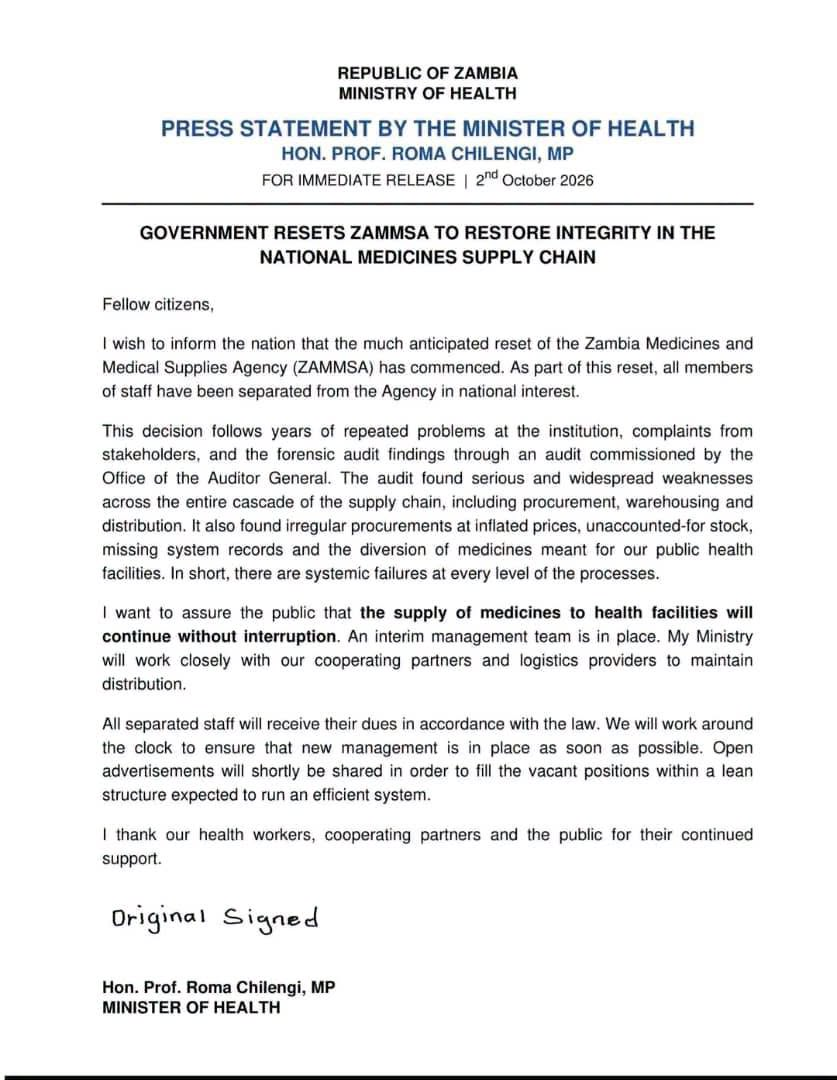
LUSAKA – The Government has effectively cleared out the entire workforce of the Zambia Medicines and Medical Supplies Agency (ZAMMSA), saying the institution has reached a point where a complete reset is necessary to restore integrity to the country’s medicines supply chain.
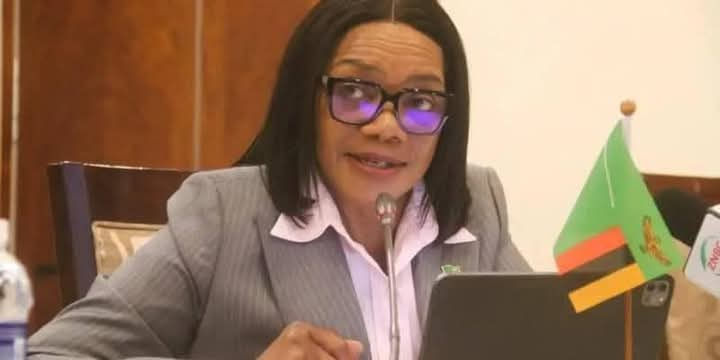
Health Minister Professor Roma Chilengi announced that all ZAMMSA employees had been separated from the agency in what he described as a decision taken “in the national interest”.
The decision follows findings from a forensic audit commissioned through the Office of the Auditor General.
According to the Minister, the audit identified serious weaknesses across procurement, warehousing and distribution, including irregular procurements at inflated prices, unaccounted-for stock, missing system records and the diversion of medicines intended for public health facilities.
“In short, there are systemic failures at every level of the processes,” Professor Chilengi said.
The Government says ZAMMSA will now be rebuilt around a leaner structure, with vacancies expected to be advertised and new management put in place.
But the decision also raises a much bigger question.
How did an agency responsible for getting medicines from procurement centres to public health facilities reach a point where Government says the entire institution needs to be reset?
This is not ZAMMSA’s first crisis
ZAMMSA has experienced a succession of management and procurement problems over several years, with different administrations attempting to address weaknesses at the agency.
The institution itself was established under the Zambia Medicines and Medical Supplies Agency Act No. 9 of 2019, taking over the functions previously associated with Medical Stores Limited.
Its mandate is fundamental to the health system: procuring, storing and distributing medicines and medical supplies and ensuring their timely availability at public health facilities.
That means failures at ZAMMSA do not remain confined to an office in Lusaka.
They can eventually be felt in hospitals, health centres and pharmacies when medicines do not arrive, arrive late, are unavailable in the required quantities or cannot be properly accounted for.
The problems go back years
Auditor General reports have previously documented weaknesses in the distribution and accountability of medicines.
A Parliamentary committee examining an earlier Auditor General follow-up audit recorded problems including delays in the distribution of medicines and the inability of ZAMMSA to consistently meet distribution schedules, with transport availability identified as one of the challenges.
Another Auditor General report recorded medicines and medical supplies worth K2.31 million that had been received at 17 stations but could not be accounted for through disposal records such as stock-control cards and supply vouchers.
The Auditor General’s 2023 report also identified medicines worth K487,768 that had been procured but remained undelivered to eight stations in three provinces as of August 2024. A further examination of delivery notes found an under-delivery of medicines worth K5,386 in two locations.
These are not findings from the latest forensic audit announced by the Minister. They are earlier audit findings that illustrate why questions about medicine management and distribution at ZAMMSA have persisted for years.
The Honeybee episode

In February 2022, ZAMMSA’s board placed the agency’s management on compulsory leave amid investigations into irregularities surrounding the distribution of defective medicines sourced from Honeybee Pharmacy.
The episode became one of the early major tests of the institution under the UPND administration.
It also contributed to a period of management instability.
Billy Mweetwa was subsequently appointed Director General in August 2022 and spoke publicly about efforts to transform the agency and strengthen the medicines supply chain.
By 2023, ZAMMSA was publicly insisting that it was pursuing greater transparency in medicine procurement.
Mweetwa said the agency had a zero-tolerance approach to corruption and acknowledged that publicly funded medicines were particularly vulnerable where procurement governance was weak.
Yet the governance problems did not disappear.
Then came the 61 containers
The next major crisis erupted in 2024.
In July that year, authorities discovered 61 containers containing assorted medicines and medical supplies at a private depot in the Makeni area of Lusaka.
The containers were among 74 that were supposed to be stored at ZAMMSA’s warehouse.
Then Health Minister Sylvia Masebo told Parliament that the containers had been diverted to the private facility without the knowledge or approval of the Ministry or the ZAMMSA board. She described the situation as gross mismanagement and negligence that could amount to possible criminality.
ZAMMSA’s then Director General Victor Nyasulu was suspended.
The board said the suspension related to the discovery of the containers and assured the public that operations would continue.
The matter subsequently contributed to Nyasulu’s departure from the agency.
The episode also demonstrated one of the recurring problems at ZAMMSA: the agency’s leadership was changing while serious questions about procurement, storage and accountability remained.
A revolving door at the top
The leadership history is important because the current reset is not simply about individual employees.
ZAMMSA has experienced repeated changes at Director General level.
Billy Mweetwa became Director General in August 2022 after the compulsory-leave episode. His tenure subsequently ended.
Victor Nyasulu took over in November 2023 but was suspended in July 2024 following the private-depot controversy involving the 61 containers.
Luke Alutuli then served as interim Director General.
Other acting arrangements followed as Government attempted to stabilise the agency.
The succession of leadership changes has been documented by observers of the health sector as part of a wider problem of institutional instability at ZAMMSA. Some accounts differ over the exact sequence and duration of individual acting appointments, so the focus should remain on the documented pattern rather than assigning responsibility for every change to a particular person.
The repeated changes matter because a medicines supply chain requires continuity.
Procurement contracts can run for years.
Suppliers need predictable processes.
Stock needs to be tracked from procurement to warehouse to health facility.
And management systems need to survive changes in individual office holders.
The forensic audit had already been demanded
The latest Government decision did not come out of nowhere.
In 2022, the Auditor General recommended that a forensic audit be conducted at ZAMMSA to determine the authenticity of receipt and disposal records. Parliament’s Public Accounts Committee urged the Treasury to support the Office of the Auditor General in undertaking that forensic audit without delay.
By July 2025, Parliament was told that a forensic audit conducted by PricewaterhouseCoopers on behalf of the Auditor General had been completed, although the report had not then been made public.
Government subsequently said the audit had produced findings serious enough to trigger action against senior officials.
Former Health Minister Elijah Muchima told Parliament that several ZAMMSA officials had been suspended or removed, including then Director General Victor Nyasulu, Director of Supply Planning Nalishebo Siyandi, Director of Procurement Nchimunya Habadu and Director of Finance Milimo Ngululu. He said some of those affected were appearing before the courts, while stressing that accused persons remained presumed innocent until proven guilty.
President Hakainde Hichilema also said in Parliament in September 2025 that the Government was using the findings of the independent forensic audit and that arrests had already been made. He said those found responsible would Face prosecution and that Government would pursue asset recovery.
The latest mass separation therefore represents the next stage of a process that has been unfolding for several years.
What exactly did the latest audit find?
The full forensic audit report has not been publicly reproduced in the Government statement announcing the staff separation.
That distinction is important.
What is currently public is the Minister’s summary of the audit findings.
According to Professor Chilengi, investigators identified:
- irregular procurement at inflated prices;
- stock that could not be accounted for;
- missing system records;
- diversion of medicines intended for public health facilities; and
- systemic failures extending across the supply chain.
These are serious findings because each part of the chain is connected.
A procurement irregularity can affect the price paid for a medicine.
A warehousing failure can result in medicines being lost, damaged or unaccounted for.
Weak records make it difficult to determine where stock went.
And diversion of medicines can directly affect public health facilities.
The Minister has described the failures as systemic rather than isolated.
Why send everyone home?
This is perhaps the most unusual aspect of the Government’s response.
Rather than replacing selected managers or departments, Government has separated the entire ZAMMSA workforce.
The stated reasoning is that the problems are so widespread that a limited change would not be enough.
Professor Chilengi has called the move a “reset” and says Government will establish a leaner structure.
That means the Government is effectively using the crisis to redesign the agency rather than simply replacing people at the top.
The Ministry says new positions will be advertised openly.
It has also promised that separated employees will receive their lawful dues.
What happens to medicines now?
This is arguably the most immediate question for patients.
ZAMMSA is responsible for the supply chain that connects medicines and medical supplies to public health facilities.
If the entire workforce has been separated, there is a risk of disruption unless the transition is carefully managed.
Government says that will not happen.
Professor Chilengi says an interim management team has been put in place and that the Ministry will work with cooperating partners and logistics providers to maintain distribution while the new structure is established.
The Minister has also said Government will work around the clock to ensure new management is put in place as soon as possible.
The success of the reset will therefore be measured not simply by how many employees are removed.
It will be measured by whether medicines continue reaching health facilities while the new system is built.
The bigger issue is accountability
The Government’s announcement raises another question: what happens after the audit findings?
Separating employees is an administrative action.
It does not, by itself, establish criminal responsibility.
Where the audit identifies conduct that may constitute an offence, the relevant investigative and prosecutorial authorities must establish individual responsibility through the legal process.
This distinction matters because a system can have serious failures without every person who worked inside the institution being personally responsible for them.
The Government has previously said that people facing allegations will go through the legal process and remain presumed innocent until proven guilty.
The public interest is therefore not only in seeing a new ZAMMSA leadership team.
It is also in seeing the audit findings translated into corrective action, stronger controls and, where evidence supports it, lawful accountability.
Can a leaner ZAMMSA fix a much older problem?
That may be the most important question of all.
ZAMMSA has had management changes.
It has had investigations.
It has had suspensions.
It has had parliamentary scrutiny.
It has had audit findings.
It has had repeated promises of stronger procurement and supply-chain management.
And yet problems have continued to surface.
The current Government response is therefore being asked to achieve something previous interventions have not fully accomplished: build an institution in which procurement is transparent, stock can be tracked, records are reliable, medicines reach their intended destinations and management remains accountable regardless of who occupies the Director General’s office.
The latest reset gives Government an opportunity to do that.
But the test will not be the number of people sent home.
The test will be what happens next.
Will the new structure strengthen accountability?
Will the full audit findings eventually be made available to the public?
Will investigations into suspected wrongdoing reach their lawful conclusion?
Will the new management remain stable?
And most importantly, will patients in Zambia’s public health facilities consistently find the medicines they need?
Those are the questions that will determine whether the ZAMMSA reset becomes another change in personnel or the beginning of a genuinely different medicines supply system.
Zambian Eye will follow the restructuring, the appointment of the new management and any further action arising from the forensic audit.