

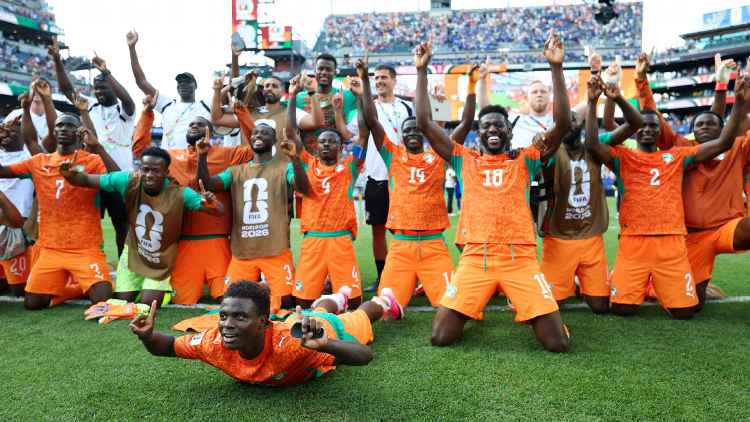

Ivory Coast’s historic run at the 2026 FIFA World Cup came to an end on June 30 with a 2-1 defeat to Norway in the Round of 32 at AT&T Stadium in Arlington, Texas.
The match marked the first time the Elephants had reached the knockout phase of the tournament, and despite the loss, their campaign was widely regarded as the most successful in the country’s World Cup history.
*How the game unfolded*
Norway struck first just before halftime through Antonio Nusa. In the 39th minute, the 21-year-old winger cut in from the left and curled a right-footed shot beyond goalkeeper Yahia Fofana to give the Norwegians a 1-0 lead. Nusa, who plays his club football in Belgium, has been one of the breakthrough players of Norway’s campaign, providing pace and creativity on the flanks.
Ivory Coast responded in the second half with energy and intent. Coach Emerse Faé introduced Manchester United winger Amad Diallo just after the hour, and the change paid off in the 74th minute. Collecting the ball near the halfway line, Diallo drove at the Norway defense, beat two defenders, and finished low into the far corner to level the score at 1-1. It was Diallo’s first World Cup goal and only the second scored by an Ivorian substitute in the tournament’s history.
The equalizer lifted the Elephants and they pushed for a winner, but Norway’s experience showed late on. In the 86th minute, Manchester City striker Erling Haaland latched onto a cross from the right, controlled with his chest, and fired past Fofana to make it 2-1. Haaland’s goal was his third of the tournament and underlined Norway’s clinical edge in front of goal. Ivory Coast pressed in stoppage time, but Norway held on to secure a place in the Round of 16.
*Context and significance for Ivory Coast*
The result ended a campaign that began with low expectations but grew in confidence as the tournament progressed. Ivory Coast qualified for the 2026 World Cup by topping their African qualifying group unbeaten, a feat that included wins over Ghana and South Africa. Drawn in Group E with Germany, Curaçao, and Japan, the Elephants opened with a 0-0 draw against Japan before recording a landmark 2-0 victory over Curaçao, their first World Cup win since 2014. A 1-2 loss to Germany was enough to see them through in second place behind the Germans.
This was Ivory Coast’s fourth appearance at a World Cup, following 2006, 2010, and 2014, but the first time they advanced beyond the group stage. Previous teams featuring Didier Drogba, Yaya Touré, and Gervinho fell short at the group phase, so reaching the Round of 32 was a new benchmark for Ivorian football.
The squad in 2026 blended Europe-based professionals with domestic league players. Alongside Diallo and Fofana, key contributors included Brighton midfielder Simon Adingra, Villarreal forward Nicolas Pépé, and captain Seko Fofana of Al-Nassr. Faé, who took charge in 2024, emphasized a transition-based style that relied on quick wide play and compact defending.
*What it means going forward*
Although the dream ended in Texas, the tournament is being framed in Abidjan as a stepping stone rather than a failure. The Ivory Coast Football Federation pointed to the experience gained by a relatively young squad, with an average age of 25.3, and the exposure of players like Diallo and N’Guessan Kouassi on a global stage. There is also renewed attention on youth development and domestic league investment ahead of the 2030 cycle.
Ivory Coast joins Senegal, Morocco, and Nigeria among African teams that exited at the Round of 32 in 2026, continuing a pattern where African sides have struggled to break into the quarterfinals since Ghana in 2010. For Norway, the win sets up a Round of 16 tie against the winner of the Brazil versus Switzerland match, with most projections favoring a meeting with Brazil.
Coach Faé said after the game that the players should leave the field with pride. He noted that reaching the knockout stage for the first time had changed the perception of Ivorian football and given supporters a new standard to expect. For a nation that won the Africa Cup of Nations in 2015 and 2023, the 2026 World Cup will be remembered as the tournament where Les Éléphants finally made it out of the group and announced themselves as a team capable of competing deep into future World Cups.