


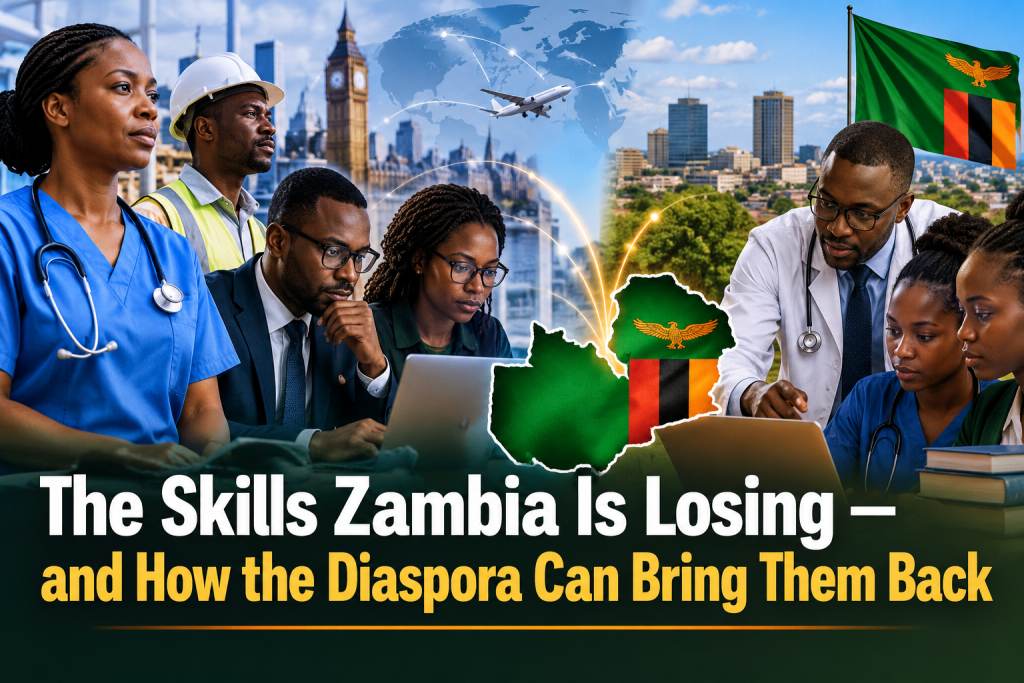
Zambians working abroad are building careers and gaining valuable experience. The challenge is how to connect that knowledge to the country they left behind.
A Zambian nurse working in the United Kingdom may have experience with care systems and technologies that are not widely available at home. An engineer in South Africa may have spent years managing complex projects. A lecturer in Australia may be conducting research that could help strengthen Zambia’s universities, while a technology professional in the United States may have skills that local businesses urgently need.
They may be thousands of kilometres away, but their knowledge remains relevant to Zambia.
The question is whether the country can create practical ways to benefit from that experience without requiring every skilled professional to return permanently.
This is the challenge behind the debate about brain drain, and it is one that deserves a broader conversation than simply asking why skilled Zambians leave.
The cost of losing skilled professionals
When experienced professionals leave, the effects can extend beyond an individual workplace. Training replacements takes time and resources, while institutions may lose experienced staff, mentors and people who understand local systems.
In sectors such as healthcare, education, engineering, agriculture and technology, the departure of experienced workers can create pressure on those who remain.
However, migration does not automatically mean a country loses every benefit associated with the people who leave. Professionals abroad can acquire new knowledge, build international networks, access research and gain experience in different working environments.
The challenge is turning those individual achievements into opportunities for Zambia.
What the research tells us about Zambians abroad
There is evidence that many Zambians living abroad are willing to contribute their expertise at home.
A 2023 International Organization for Migration (IOM) survey of the Zambian Diaspora in South Africa, the United Kingdom and the United States examined respondents’ backgrounds, skills, connections to Zambia and willingness to participate in national development.
The report found that 93.1 per cent of respondents expressed interest in temporarily returning to Zambia through skills-transfer programmes, if such opportunities were available.
That finding is significant. It suggests that contributing to Zambia does not necessarily require permanent relocation. Some professionals may be willing to return for a short period to train others, support institutions, share specialist knowledge or work on particular projects.
The survey covered targeted countries and its respondents should not be treated as a complete representation of every Zambian living abroad. Nevertheless, it offers an important indication of the potential for structured engagement.
Bringing knowledge home without bringing everyone home
One way to approach the issue is to separate the transfer of skills from the permanent return of workers.
A specialist could spend two weeks training healthcare workers. A university lecturer could supervise research or deliver guest lectures remotely. An engineer could mentor graduates working on infrastructure projects, while a business executive could advise local entrepreneurs on financial management and international markets.
These arrangements could take several forms:
- Short-term professional placements: Experienced Zambians return for defined assignments in hospitals, colleges, universities, businesses or public institutions.
- Remote mentoring: Professionals abroad support students, graduates and early-career workers through structured online programmes.
- Institutional partnerships: Zambian organisations work with universities, hospitals, research centres and companies abroad to exchange knowledge.
- Professional training: Diaspora specialists help develop courses, improve workplace practices and train local instructors.
- Business and technology collaboration: Professionals connect Zambian firms with international expertise, suppliers, markets and potential partners.
For these initiatives to work, they need clear objectives, suitable local partners and a way to measure results. A successful programme should leave behind stronger skills and institutions, not simply a record of meetings.
Healthcare: An opportunity for skills transfer
Healthcare illustrates why the issue matters.
Zambia needs trained professionals who can deliver quality care, supervise junior staff and support the development of specialist services. Zambians working in healthcare systems abroad may have experience in clinical practice, patient safety, digital health, rehabilitation, elderly care and hospital management.
Their contribution could include specialist training, professional mentoring, curriculum development and partnerships between institutions.
For example, a Zambian healthcare professional abroad could collaborate with a local training institution to provide practical instruction, help develop learning materials or mentor newly qualified workers.
Such initiatives would need to respect professional registration requirements, clinical standards and the responsibilities of the institutions involved. They would also need to complement, rather than replace, investment in Zambia’s own healthcare workforce.
The same principle applies to education, agriculture, mining, engineering, finance and technology.
Why good intentions may not be enough
A willingness to help does not automatically translate into a successful programme.
Professionals abroad may not know which Zambian institutions need their expertise, who to contact or whether their contribution would be recognised. Local organisations may struggle to identify suitable specialists or design projects that make effective use of their time.
Other barriers can include travel costs, professional licensing, limited funding, unclear responsibilities and a lack of continuity after a placement ends.
Trust also matters. Diaspora professionals need confidence that their expertise will be taken seriously and that the organisations they partner with are prepared to put agreed plans into practice.
Zambia therefore needs more than appeals for citizens abroad to remember home. It needs practical arrangements that make contributing to national development worthwhile and effective.
Can Zambia organise its Diaspora’s skills?
The Government launched Zambia’s National Diaspora Policy in April 2019 to provide a framework for engaging citizens abroad in national development.
The policy identifies knowledge and skills transfer, technology, investment, remittances and cooperation between the Diaspora and Zambian institutions among the areas with development potential. The Ministry of Foreign Affairs and International Cooperation also operates a Zambia Diaspora Portal intended to strengthen communication and engagement with Zambians living abroad.
These are important foundations. The next challenge is ensuring that the opportunities translate into accessible programmes and lasting partnerships.
A practical approach could begin with identifying professionals who are willing to contribute, recording their areas of expertise and matching them with specific needs in Zambia.
Hospitals, universities, colleges, technical institutions, local authorities and businesses could identify projects that would benefit from external expertise. Diaspora associations could help connect professionals to those opportunities.
Clear agreements would then establish the objectives, duration, responsibilities and expected outcomes of each partnership.
Such a system would also help distinguish between a general expression of interest and a commitment to undertake a particular assignment.
What would make skilled Zambians return?
For some professionals, permanent return may be an aspiration. For others, family responsibilities, career opportunities, financial commitments or children’s education may make it difficult.
That does not mean they have abandoned Zambia.
A professional might be willing to return for a short assignment but not relocate. Another might invest in a local business, support a training programme or collaborate with a university while continuing to work abroad.
The country can benefit from recognising these different forms of engagement rather than treating permanent return as the only measure of commitment.
At the same time, if Zambia wants more skilled citizens to return permanently, the issues that influence that decision matter: professional opportunities, working conditions, career progression, institutional support and the ability to apply one’s expertise effectively.
Appeals to patriotism alone cannot resolve practical concerns.
Turning brain drain into knowledge exchange
The debate should not be reduced to whether Zambians are right or wrong to seek opportunities abroad. People move for many reasons, including education, employment, family and professional development.
The more useful question is how Zambia can maintain meaningful connections with its skilled citizens wherever they live.
That requires cooperation between government, professional bodies, educational institutions, private businesses, Diaspora associations and the professionals themselves.
It also requires recognising that knowledge transfer is a two-way process. Zambian institutions can learn from international experience while adapting solutions to local needs and circumstances.
The goal should not be to depend on professionals abroad to fill every gap. It should be to strengthen the capacity of people and institutions at home.
The opportunity Zambia cannot afford to overlook
The findings of the IOM survey point to a potential resource: Zambians abroad who are interested in sharing their skills and experience through temporary return programmes.
The opportunity now is to make participation practical. That means identifying real needs, connecting them with suitable professionals, supporting partnerships and measuring what changes as a result.
For a young graduate in Zambia, the benefit could be access to an experienced mentor. For a college, it could mean stronger training materials and industry connections. For a hospital, it could mean specialist knowledge shared with local staff. For a business, it could mean access to new markets or better management practices.
These are possible outcomes, not automatic guarantees. They depend on planning, resources and sustained cooperation.
As Zambian Eye explores the relationship between Zambia and its people abroad, the issue of skills transfer raises a question worth asking: what could change if the experience Zambians gain around the world became more directly connected to the opportunities and needs at home?
Zambia may not be able to persuade every skilled professional to return permanently. But it can work towards ensuring that distance does not prevent their knowledge, networks and experience from contributing to the country’s future.