


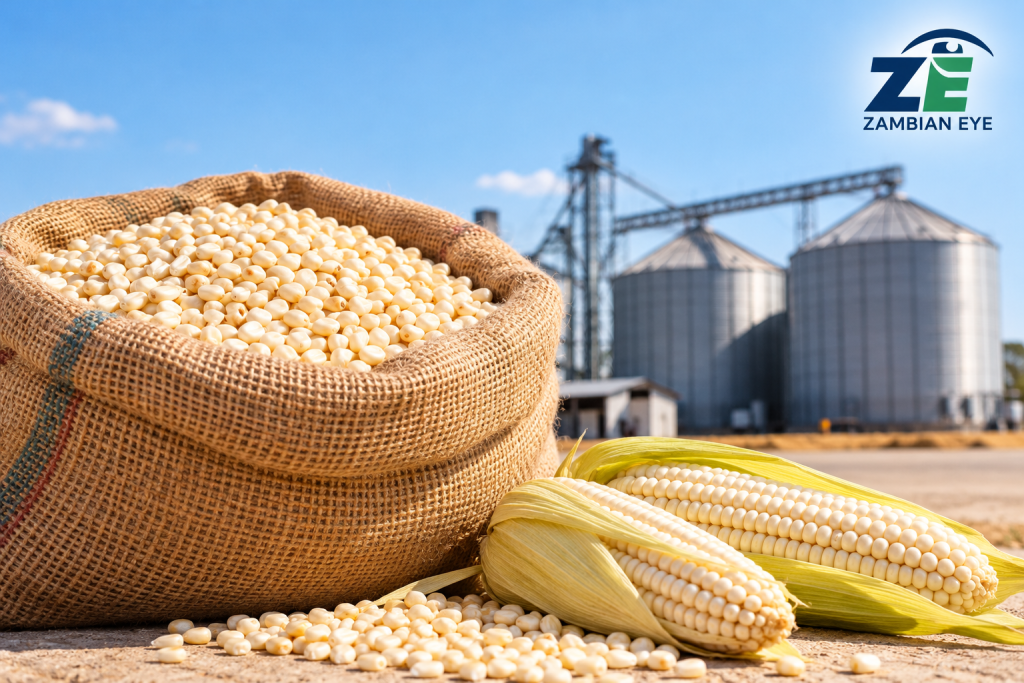
LUSAKA — Zambia’s bumper maize harvest was supposed to be an opportunity to strengthen food security, support farmers and build reserves ahead of a potentially difficult 2027 season. But the Government’s latest request for an additional K19.9 billion in public spending has raised a bigger question: how should Zambia pay for the cost of buying so much maize, and what does the decision mean for taxpayers and the wider economy?
Finance and National Planning Minister Situmbeko Musokotwane has presented Supplementary Estimates of Expenditure No. 2 of 2026 to Parliament, with K14.7 billion earmarked for payments to farmers who supplied maize to the Food Reserve Agency (FRA).
The request follows an extraordinary expansion in the agency’s purchases. According to the minister, the FRA bought 2.7 million metric tonnes of maize against an original target of 500,000 tonnes — more than five times the planned volume.
The decision has two sides. On one hand, the Government says it took advantage of a bumper harvest to strengthen national food reserves. On the other, the scale of the purchases has created an additional financing requirement that was not fully covered by the original budget.
This is the story beyond the headline: Zambia has more maize in its public reserves, but the country must now manage the financial cost, settle farmers’ payments and ensure the grain is stored and used effectively.
K19.9 billion: where is the money going?
The proposed supplementary budget allocates most of the additional expenditure to agriculture.
The Ministry of Agriculture is set to receive K15.8 billion, representing about 79 percent of the proposed package. Of that amount, K14.7 billion is intended for maize suppliers, while K1.1 billion would support the 2026/2027 Farmer Input Support Programme through the e-voucher scheme.
Other allocations include K1.3 billion for the Ministry of Finance and National Planning, K540 million for shortfalls in student tuition and allowance payments administered by the Higher Education Loans and Scholarships Board, K422.5 million for higher-than-anticipated operational costs in the defence sector and K300 million under the Contingency Vote.
The estimates also include additional funding linked to Zambia Revenue Authority customs-processing fees and World Bank-supported projects. The reported headline allocations do not account for every kwacha of the K19.9 billion total, so the full supplementary estimates should be examined to establish the complete breakdown.
The important point is that this is not a maize-only budget. Although payments to farmers dominate the request, the supplementary estimates also address other expenditure pressures that Government says have emerged during the year.
Why did the FRA buy more than five times its target?
The FRA’s original target was 500,000 tonnes. Its eventual purchases reached approximately 2.7 million tonnes.
That is an increase of 2.2 million tonnes above the initial target, or 5.4 times the original volume.
Government’s explanation is that the bumper harvest provided an opportunity to replenish strategic reserves ahead of an anticipated lean period in 2027, which the Finance Minister linked to the expected effects of El Niño.
There is a clear food-security argument for maintaining adequate reserves. A country that holds sufficient grain can be better placed to respond to drought, supply disruptions and emergencies. Strategic stocks may also help the Government respond to shortages without depending entirely on imports.
But the size of the purchase raises questions about planning.
When the FRA set its initial target, what assumptions informed the 500,000-tonne figure? How did the Government decide to expand purchases so substantially? Were the financial implications, storage requirements and payment obligations fully assessed as the buying programme expanded?
These questions do not establish that the decision to buy more maize was wrong. They are the questions that should be answered when public spending increases substantially beyond the original plan.
The Government’s food-security objective and the need for sound financial planning can both be legitimate priorities. The challenge is to ensure that one does not undermine the other.
The biggest financing question: K18 billion in domestic borrowing
The Government proposes to finance the supplementary budget largely through domestic borrowing.
Of the K19.9 billion requested, K18 billion is expected to come from borrowing on the domestic market. Other proposed sources include K1.3 billion in additional revenue collections, K510.8 million in additional donor funding, K82.9 million in savings on external debt service and K27.3 million in unspent balances carried forward from 2025.
This means domestic borrowing accounts for roughly 90 percent of the supplementary request.
Borrowing is not automatically bad. Governments borrow to meet expenditure needs, manage cash flows and respond to unexpected events. The question is whether the additional borrowing is affordable and how it affects other priorities.
Domestic borrowing can increase the Government’s interest bill. Depending on market conditions, it may also compete with businesses for financing, potentially making credit more expensive or harder to obtain. The actual effect will depend on the terms of the borrowing, investor demand, liquidity in the financial system and the wider monetary environment.
For a business seeking a loan to expand production, a farmer looking for working capital or a company considering new investment, the cost and availability of finance matter.
The Government therefore needs to explain not only why the supplementary spending is necessary, but also how the borrowing will be managed and what it means for the wider economy.
The revised borrowing plan and the terms under which the additional funds are raised will be important in assessing the full impact.
Farmers are still waiting for their money
The immediate human dimension of the supplementary budget is the payment of farmers who supplied maize to the FRA.
For farmers, delivering grain is not the end of the agricultural season’s financial responsibilities. Many must prepare for the next planting season, purchase seed and fertiliser, pay workers, meet household expenses and service existing obligations.
Delayed payment can disrupt those plans, particularly for small-scale farmers who depend on proceeds from one harvest to finance the next.
On October 17, Vice-President Mutale Nalumango told Parliament that the Government was continuing to pay farmers and would settle outstanding amounts as soon as possible, but she did not provide a specific date for completing the payments. The latest supplementary estimates seek additional resources to meet the outstanding maize-payment obligations.
The practical test is therefore straightforward: how quickly will the money reach the farmers who supplied the grain?
A budget allocation is not the same as a completed payment. Parliament must consider the estimates, the funds must be made available and the payment process must be completed.
The Government should provide a clear account of the outstanding amounts, the number of farmers awaiting payment and the expected payment timetable. Regular public updates would help farmers plan and allow citizens to assess whether the promised funds are reaching their intended beneficiaries.
For the farmers, the value of the supplementary budget will ultimately be measured not by the amount announced in Parliament, but by when the money arrives in their accounts or is otherwise paid to them.
Where will all the maize be stored?
Buying 2.7 million tonnes of maize creates a logistical responsibility as well as a financial one.
The grain must be transported, received, weighed, stored, monitored and protected against moisture, pests and other causes of deterioration. It must also be managed in a way that preserves its quality until it is needed.
The FRA has previously outlined the logistical demands associated with its record purchases. In September, the agency said its 2026 crop-marketing exercise had recorded more than two million tonnes of maize, with further quantities expected as the season closed. It also described the need to move stocks from buying locations to safe storage facilities.
The larger the reserve, the more important effective stock management becomes.
If grain is lost or deteriorates in storage, the country may pay for maize that cannot be used to its full intended value. If storage and distribution are well managed, the reserves can provide protection against future shortages.
The public should therefore be able to see how much maize has been received and verified, how much is in storage, where the stocks are held, what storage and handling costs are being incurred, and what measures are in place to prevent losses.
The Government’s food-security objective will be stronger if the public can see that the grain purchased with public money is being properly accounted for and preserved.
Will the reserves protect Zambia in 2027?
Government’s explanation links the expanded purchases to preparations for a potentially difficult 2027 season.
If the expected supply pressures materialise, the additional stocks could prove valuable. They could help meet domestic needs and reduce the risk that a poor harvest translates into shortages.
But the benefits depend on the quality of the forecasts, the condition of the grain, the size of the eventual supply gap and the way the reserve is released and managed.
If the country has more grain than it needs at a particular point, the Government may also need to consider how to manage stocks without destabilising the market or undermining farmers’ prices. Decisions about releasing or exporting reserves must take account of domestic food availability, market conditions and the applicable legal framework.
A strategic reserve should not simply be measured by how much maize is purchased. It should be assessed by whether it provides reliable protection against shortages at a reasonable and transparent cost.
The relevant question is not whether Zambia should maintain food reserves. It is how to ensure that the reserves deliver food security while limiting avoidable financial and physical losses.
What should Parliament scrutinise?
The supplementary estimates have been referred to the Expanded Planning and Budgeting Committee for consideration and a report to the House. The proposal remains subject to parliamentary approval.
Parliament’s scrutiny should go beyond accepting the headline rationale for the expenditure. Several questions deserve clear answers.
First, procurement planning: What led to the FRA buying 2.7 million tonnes against a 500,000-tonne target, and how were the additional costs assessed as purchases expanded?
Second, payment obligations: What amount remains outstanding to farmers, how many suppliers are affected and what timetable is proposed for settling the arrears?
Third, storage and stock management: What is the available storage capacity, what is the cost of transporting and holding the grain, and what controls will protect the stocks against losses?
Fourth, borrowing and affordability: What are the expected terms of the additional K18 billion in domestic borrowing, how will the funds be raised and what will the additional debt-service costs be?
Fifth, accountability: What reporting will be made available to Parliament and the public to show how the supplementary funds were spent and what quantity of usable grain remains in the reserve?
These are not questions that assume wrongdoing. They are standard questions of public financial accountability when the Government seeks a substantial increase in spending.
Parliament’s responsibility is to consider whether the additional expenditure is justified, properly financed and subject to adequate controls.
The wider lesson: a bumper harvest needs a financial plan
Zambia’s experience highlights the connection between agricultural policy and public financial management.
Supporting farmers, building reserves and preparing for possible drought are legitimate public objectives. But they require coordination between agricultural forecasts, procurement targets, storage infrastructure, cash-flow planning and the national budget.
If the FRA’s purchasing plans are significantly exceeded, the financial implications should be assessed and communicated as early as possible. That would help the Government manage the payment schedule, plan borrowing and explain the choices to Parliament and the public.
Better planning does not mean the FRA must never buy more than its original target. Harvests, prices and food-security risks can change. It means that when circumstances change, the Government should have a transparent process for adjusting the target, estimating the cost and explaining how the additional commitments will be financed.
The public should also be able to assess whether the cost of the reserve is proportionate to the protection it provides.
That is how the Government can demonstrate that food security and fiscal discipline are complementary goals rather than competing promises.
The verdict will be in the delivery
The K19.9 billion supplementary budget presents Zambia with a significant financial decision. The Government says it needs additional spending authority to pay maize suppliers, support the agricultural programme and meet other expenditure obligations. Most of the proposed funding would be raised through domestic borrowing.
The decision to build reserves may offer real protection if the country faces a difficult 2027 season. But the public interest requires more than the announcement of a large purchase or a substantial supplementary allocation.
Farmers need to be paid. Grain must be stored safely. Borrowing must be managed responsibly. And Parliament and the public need sufficient information to judge whether the money has achieved its intended purpose.
A bumper harvest should be an opportunity for farmers and the country. Whether it becomes a lasting economic gain will depend on how well Zambia manages the money, the maize and the obligations created by the decision.
The central question is no longer just how much maize Zambia has bought. It is whether the country can turn that harvest into food security, reliable farmer payments and a well-managed public investment — without creating avoidable pressure on the national budget.