


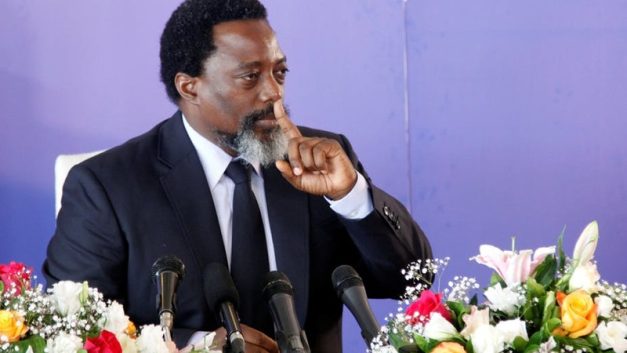
GOMA – Former Democratic Republic of Congo (DRC) President Joseph Kabila has formally launched a new political-military coalition incorporating the M23 rebel movement, taking a more direct leadership role in the armed opposition challenging President Félix Tshisekedi’s government.
The new coalition, known as the Front for the Refoundation of the Nation (FRN), was announced on Monday, October 12, 2026, at a news conference at Kabila’s residence in Goma, the eastern Congolese city that M23 captured in January 2025.
The announcement marks a significant development in a conflict that has displaced communities, disrupted livelihoods and complicated diplomatic efforts to restore stability in eastern Congo.
Kabila, who governed the country from 2001 to 2019, will lead the new coalition alongside figures associated with M23 and its political umbrella, the Congo River Alliance, known by its French acronym AFC.
The development also sharpens the confrontation between Kabila and his successor, Tshisekedi, whose government has accused the former president of supporting the rebellion.
However, the announcement does not mean that M23 has been dissolved. Rather, the new coalition brings the armed movement and associated political groups into a broader political-military framework.
What is the new coalition?
The Front for the Refoundation of the Nation brings together several groups opposed to Tshisekedi’s government, including M23 and factions previously operating under the AFC.
Coalition adviser Claude Ibalanky announced the formation at the Goma news conference, saying the participating groups had decided to pool their forces, resources and capabilities under a common structure.
He described the coalition’s objective as restoring the foundations of a functioning republic and coordinating resistance forces to end what the movement calls tyranny.
Ibalanky said the coalition intended to pursue its objectives “by any means necessary, including the use of force”.
That language is significant because the new organisation is not simply a political opposition alliance. Its membership includes an armed movement that has fought Congolese government forces and seized territory in the east.
Kabila will head the coalition, while senior figures associated with the rebellion and its political leadership will serve as deputies. They include Corneille Nangaa, the former head of the DRC’s electoral commission who leads the AFC, and Sultani Makenga, the military commander of M23.
The coalition’s formation brings political leadership associated with the former president into a more formal relationship with the armed movement.
Why Kabila’s role matters
Kabila’s involvement is particularly consequential because of his former position as head of state and the legal proceedings brought against him by the current government.
He governed the DRC from 2001 until 2019, having succeeded his father, Laurent-Désiré Kabila, following his assassination in 2001.
His presidency covered a critical period in the country’s post-war political development. It also ended after years of tension over delayed elections and the extension of his rule beyond the end of his constitutional mandate.
Tshisekedi succeeded him in January 2019, in a transfer of power that marked the first peaceful transition between presidents in the DRC’s history.
Relations between the two men subsequently deteriorated. Kabila’s political camp has increasingly opposed Tshisekedi’s administration, while the government has accused Kabila and his associates of links to the rebellion in the east.
Kabila had previously denied involvement with M23. His formal leadership of the new coalition now places him at the head of an organisation that openly incorporates the rebel movement and its political allies.
That is a major political development, although it does not by itself establish the extent of Kabila’s previous operational involvement in the insurgency.
The death sentence hanging over Kabila
In September 2025, a military court in Kinshasa sentenced Kabila to death in absentia after convicting him of offences including treason, war crimes and crimes against humanity.
The proceedings concerned allegations that he collaborated with M23 and neighbouring Rwanda. Kabila was not present for the trial and rejected the accusations, describing the proceedings as politically motivated.
The verdict deepened the political confrontation between the former president and the government in Kinshasa.
The new coalition’s formation comes after those proceedings and following further accusations of support for armed groups in eastern Congo.
In February 2026, the United States imposed sanctions on Kabila over his alleged role in financing and providing political support to rebel groups operating in the country’s east.
The coalition announcement therefore comes against a background of legal, diplomatic and political pressure surrounding Kabila’s alleged relationship with the insurgency.
His leadership of the FRN is now public, but the charges against him and the political dispute surrounding his prosecution remain important context for understanding the development.
M23’s control of eastern Congo
M23 is one of numerous armed groups operating in the mineral-rich eastern provinces of the DRC, a region that has experienced decades of conflict involving local militias, Congolese forces and neighbouring states.
The group captured Goma, the capital of North Kivu, in January 2025 before expanding its territorial control and taking other strategic locations.
Its advances have raised concerns about the authority of the Congolese government in the east and the humanitarian consequences for civilians living under shifting front lines.
The DRC, the United States and United Nations experts have accused Rwanda of supporting M23. Rwanda has denied backing the rebellion.
The conflict is also tied to regional security concerns, competition over territory and mineral resources, and longstanding disputes involving armed groups and communities in eastern Congo.
M23’s territorial gains have allowed it to establish administrative structures in areas under its control, further complicating efforts by Kinshasa to restore state authority.
The creation of the FRN adds a new political dimension to that situation by placing the former president at the head of a coalition that includes the armed movement.
What does this mean for peace negotiations?
The announcement presents a new challenge for efforts to end the conflict.
The Congolese government and AFC/M23 have been involved in negotiations facilitated by Qatar in Doha, while the United States has pursued a parallel diplomatic effort involving the DRC and Rwanda.
These initiatives have sought to address the conflict and reduce regional tensions, but fighting has continued despite diplomatic engagement.
The new coalition could complicate negotiations because the movement now has a more formal political structure under Kabila, while the armed leadership remains involved.
A researcher quoted by the Associated Press said the announcement could signal a more direct confrontation between Kabila and Tshisekedi. Other analysts have warned that the development could make an already difficult peace process more complicated.
The practical effect will depend on whether the coalition changes the movement’s military strategy, political demands or willingness to negotiate.
The announcement does not, by itself, establish that peace talks have ended. It does, however, raise questions about how existing negotiations will accommodate a new coalition that combines opposition political figures with an armed movement.
Congolese government officials had not issued an immediate response to the coalition’s launch in the reporting available at the time of publication.
A wider political challenge to Tshisekedi
The coalition is also a direct challenge to Tshisekedi’s administration.
In a speech shortly before the announcement, Kabila accused the government of corruption, poor governance and military setbacks in eastern Congo. He also criticised its approach to mineral agreements with the United States.
The new front presents itself as a movement to restore governance and coordinate opposition to the current administration. Its stated willingness to use force, however, distinguishes it from an ordinary political party or a conventional electoral alliance.
The extent to which the coalition can translate its political leadership into additional military capacity remains uncertain. Its formation brings groups together under a common structure, but it does not automatically establish that their battlefield strength or territorial control will increase.
For civilians in eastern Congo, the immediate concern remains whether the announcement will be followed by further fighting, changes in control of territory or new displacement.
What happens next?
The formation of the Front for the Refoundation of the Nation marks a new stage in the relationship between Kabila’s political camp and the M23 rebellion.
For the former president, it represents a public move into leadership of a coalition that includes an armed movement he had previously been accused of supporting.
For Tshisekedi’s government, it creates a more clearly defined political-military opponent whose leadership includes a former head of state.
For regional and international mediators, the announcement raises questions about the future of peace negotiations and the conditions required to end the fighting in eastern Congo.
The most immediate issue is whether the new coalition will alter military operations or primarily formalise an alignment that has already developed.
What is clear is that M23 has not simply disappeared or been officially dissolved. Instead, it has become part of a broader coalition led by Kabila, placing the former president more openly at the centre of the conflict.
The consequences will depend on what the coalition does next — on the battlefield, at the negotiating table and in its dealings with the Congolese population.